
Accessible... but
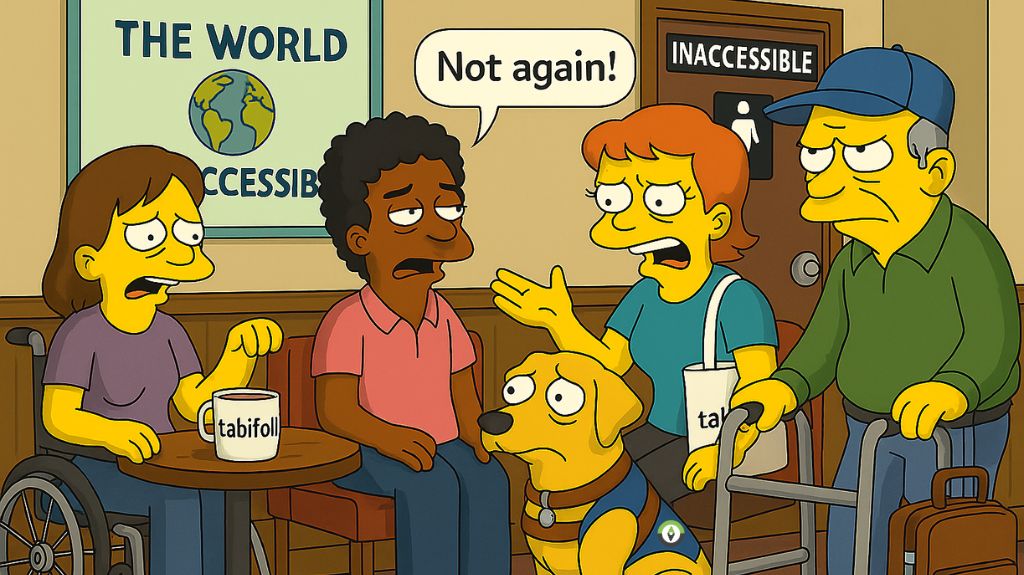
This piece began with a simple but revealing question posed by tabifolk in our Facebook group: “What problems do disabled travelers face that most people don’t even notice?”
If you’ve ever traveled with a disability, you likely already know the answer. But reading through the replies — raw, honest, often heartbreakingly familiar — I was struck by how deeply shared this frustration is.
Some responses made me laugh out of recognition (because if we didn’t laugh, we might cry). Others just made me sit back and sigh. This isn’t a how-to guide or a manifesto for change, though we desperately need both. It’s something else: a collective exhale. A way of saying: Yes. That happens. I’ve been there too.
And with that, consider this your invitation to join in—comment, rant, reflect, share whatever needs to be said. Add your voice to the thread here, or over at tabifolk.
The word “accessible” sounds like it should make things easier, but too often, it just means more expensive. (See: Accessible Travel Costs: Is the Price Justified?) And it’s exhausting. After tabifolk’s post, Kelly shared how she had to book private tours because group options wouldn’t accommodate wheelchairs or service animals. Tanya was charged extra for a second suitcase filled with medical equipment. Debbie paid hundreds for accessible airport transfers. Even needing two beds and a functional bathroom often means booking an expensive suite. Inclusion, it seems, comes with a premium price tag.
Bathrooms—such a basic need—are a constant gamble. Annie shared how she sometimes skips food and drink while out, just to avoid the stress of finding an accessible restroom. Kristy called airplane bathrooms “impossible” to use with a wheelchair. I couldn’t agree more. (See: Accessible bathrooms on planes: what are my options?) These spaces feel less like restrooms and more like stress tests. And the aisle chair? Let’s not pretend it’s anything but a humiliation.
Then there are the so-called “minor” things that add up fast: beds so high you need a running start to climb in. Thick carpets that drag and stall your wheels. Doors with springs so aggressive they feel designed to keep you out. Michelle, Jan, and Heather all reminded us how easily one of these seemingly small obstacles can derail an entire trip. One door, one mattress, one hallway can set the tone for everything that follows.
Spontaneity? Forget it. Chester said it best: the planning takes longer than the trip. Yvette pointed out that last-minute deals don’t exist when accessible rooms are few and poorly described. We email, call, follow up, plead for photos, pack backup equipment, then backups for our backups—and still arrive at locked ramps and “accessible” entrances that are anything but.
And sometimes, it’s not a major failure that ruins the trip—it’s one overlooked detail: a single step, a patch of gravel, a locked gate. Karen and Angela both reminded us how fragile access really is. It only takes one thing to break it.
Traveling with a service animal is its own constant negotiation. As Zoë shared, it’s not just about logistics, but safety too. The presence of stray animals, lax enforcement of pet policies, and public ignorance can all put a working dog at risk. Add to that the endless interrogations from strangers, “Is that really a service animal?”, and it becomes clear that access isn’t only about infrastructure. It’s also about social permission. The burden of proof, the stares, the skepticism—it all chips away at your sense of ease, at your right to simply be in a space without justification.
And this is what so many people miss: the weight of having to constantly self-advocate, explain, preempt problems, and brace for barriers. I’m not writing this to be inspirational or to invite pity. We don’t need applause. We need acknowledgment of the very real cost of navigating systems and spaces that weren’t designed with us in mind.
We fight for change. We build community. We push forward. But that doesn’t mean we’re unaffected. The exhaustion is cumulative. And sometimes, what we need most is the space to speak plainly—to say: this is hard, this is unfair, and I’m tired—without being expected to turn that pain into a TED Talk.
So if you’re reading this and recognizing your own experience, know this: you are not alone. The frustration is real. The fatigue is valid. And naming it is not weakness—it’s resistance. Sometimes, the most radical act is to stop pretending it’s fine, and to say what so many of us carry quietly: this should not be so difficult.
Head to tabifolk.com and create your free account, today!
Join a community of travelers making the world a little more accessible with every trip.
Join HereTWIA
Although all hotel and vacation rental information on this site is thoroughly vetted, we recommend calling ahead to ensure your needs are met.
Newsletter Sign Up:
Thank you!
You have successfully joined our subscriber list.
5 thoughts on “Accessible… but.”
I am a fulltime wheelchair user, I went on a P&O cruise to Norway this year. The excursions for me were so limited. The only one I could access was an accessible transport vehicle but only had 1 space for a wheelchair user. I went on it, felt so separate from the rest of the passengers. The stops on the accessible vehicle were for a very short time, so didn’t feel able to get off the transport and see the views. I felt very disadvantaged. The talking guide on the transport was very good though, I did learn a lot about what it is like to live in Norway.
Ah, I really feel for you — that sounds like such a frustrating experience. It’s wild how often “accessible” options turn out to be technically accessible, but in practice, just isolating or limiting. I know exactly what you mean about feeling separate from the rest of the passengers — that sense of being on the outside looking in can totally take the joy out of what should be an incredible trip.
And yeah, those whistle-stop tours where you barely have time to get your bearings before being whisked off again… not ideal. I’m glad the guide was good and you got to learn something meaningful, but still — you shouldn’t have to choose between access and actually enjoying the experience properly.
Thanks for sharing this. It’s a reminder that even when companies try, there’s still a huge gap between “available” and equitable.
We are going on P & O to Norway in August. Can you tell me which trip please? Did you do your own thing on any of the other ports? How did you find it please?
I did that cruise too but use a mobility scooter. There were no trips suitable for me so I rarely got off the boat. Wheelchairs were just about catered for, scooters weren’t. Very disappointing
Two things I’ve found common when traveling with my disabled husband- accessible hotel showers and accessible hotel rooms are very rare. Generally the front desk people and those who make the reservation have never even seen the inside of the room. They go by a computer code that merely says it is accessible even though that can mean many different things. We specifically need a roll-in shower and are frequently told that we have one only to find it is a tub and the only thing that makes the room “accessible” is a doorbell and lights that flash so the deaf can be alerted to visitors at the door or a fire alarm that they can’t hear. If there is a roll-in shower, there will be only one in the entire hotel and they already put someone who didn’t need it in that room. Then there is the roll-in showers with the bench bolted on the back wall and the shower head on the opposite wall so that the two are impossible to use at the same time. The water doesn’t reach the bench. Some hotels also bolt large containers of shampoo and soap to the wall that cannot be reached from a seated position.