
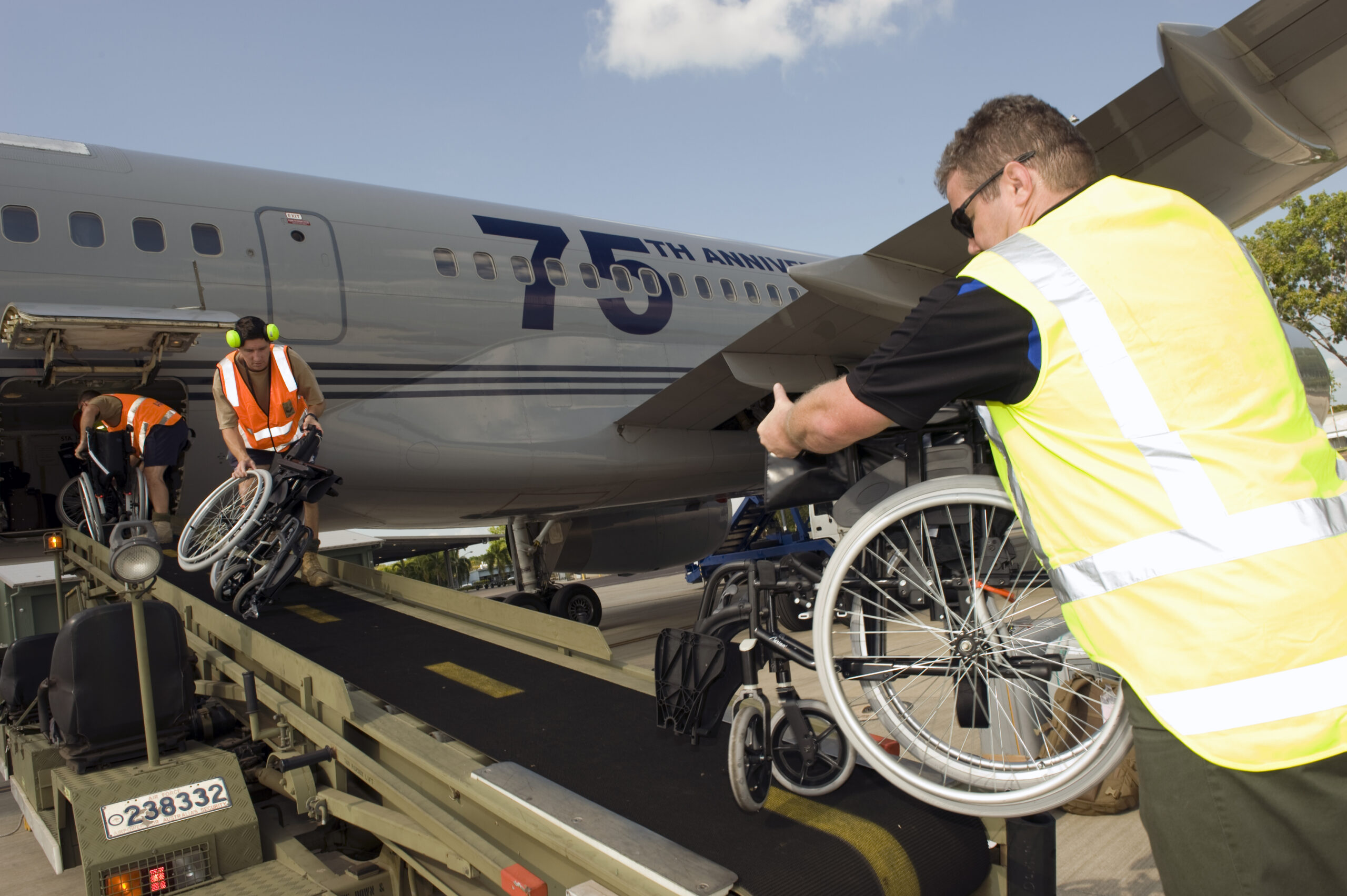
Can you imagine taking a flight, arriving at your destination and being informed that your wheelchair or mobility device has been damaged? Well, for a lot of you reading this article, you don’t have to imagine — you’ve lived it. In fact, for millions of people around the world that rely on wheelchairs, scooters, walking frames, you name it — it’s a recurring nightmare, with over 11,000 incidents per year, in the U.S. alone, where airlines and/or ground staff damage or lose a customer’s mobility aid.
That figure isn’t simply pie in the sky. The Department of Transportation (U.S.) revealed that U.S. airlines mishandled more than 11,000 wheelchairs and scooters throughout 2024. Staggeringly, that equates to over 30 per day. And while the overall mishandling rate has declined slightly, from 1.38% of transported devices in 2023 to 1.26% in 2024, the human cost of each incident remains immense.
A custom power wheelchair can cost anywhere from $25,000 to well over $75,000. It is not just a piece of equipment. For its user, it is independence. It is the ability to work, to travel, to participate in daily life. When an airline drops it from a cargo hold, the damage is not a mere inconvenience — it is, in the words of many wheelchair users and advocates, the equivalent of breaking someone’s legs.
The data on wheelchair mishandling has been publicly available since 2019, when U.S. Congress — through the FAA Reauthorization Act of 2018 — first required airlines to report such figures. Senator Tammy Duckworth of Illinois, a combat veteran and double amputee who has had her own wheelchair damaged by airlines multiple times, was instrumental in passing the requirement.
What the data revealed was nothing short of sobering. In 2019, airlines reported more than 10,000 mishandled mobility devices. By 2022, that number had climbed to 11,389. In fact, damaged mobility devices increased by 57% in 2022, compared to the 2021 figures (7,239), yet the number of mobility devices carried only increased by 34%. The problem, in other words, was growing faster than air travel itself. The drop in damages throughout 2021 can also be attributed to the COVID-19 pandemic.
The consequences fall disproportionately on people who can least absorb them. A damaged wheelchair can leave someone stranded in an airport, unable to work, unable to get home, or dependent on a loaner device that may not fit their body or meet their medical needs. Replacement and repair timelines can stretch from weeks to months, during which time the user may face serious health risks — including pressure sores from ill-fitting chairs, falls, or an inability to perform basic self-care.
One victim of such an incident, disability rights activist Engracia Figueroa, died in October 2021 from injuries sustained while using a replacement wheelchair provided by United Airlines after her own $30,000 custom device was damaged by the carrier. Her death became a rallying point for advocates demanding greater accountability.
Not all carriers perform equally. Based on full-year 2024 data compiled by DOT and analysed by wheelchair travel expert John Morris of WheelchairTravel.org, there are meaningful differences in how airlines handle passengers’ mobility devices.
Spirit Airlines, which had the worst rate of any major carrier in 2023 at 5.35%, saw its mishandling rate fall sharply to 2.07% in 2024 — the biggest improvement of any airline. American Airlines has also shown a multi-year downward trend, moving from a 2.01% mishandling rate in 2022 to 1.41% through the first nine months of 2025, partly as a result of a landmark DOT enforcement action.
That enforcement action — a $50 million penalty against American Airlines issued in October 2024 — was the largest fine ever levied for disability-related violations in air travel. The DOT cited cases of unsafe physical assistance and wheelchair damage spanning 2019 to 2023, involving passengers who were handled roughly and whose devices were damaged beyond repair. Of the total penalty, $25 million went to the U.S. Treasury; the remaining $25 million was credited back to American to fund equipment upgrades, wheelchair lifts, improved tagging systems, and direct compensation to affected passengers.
These fines represent meaningful accountability, but advocates note they remain exceptional rather than routine — and that they come only after years of documented harm.

In December 2024, during the final weeks of the Biden administration, the DOT issued a sweeping new regulation — formally titled ‘Ensuring Safe Accommodations for Air Travelers With Disabilities Using Wheelchairs,’ and quickly nicknamed the Wheelchair Rule. Advocates celebrated it as the most significant step forward for disabled air travelers in decades.
The rule required airlines to provide annual hands-on training for staff who physically assist passengers with disabilities or handle mobility devices. It mandated that airlines return a mishandled wheelchair within 24 hours for domestic flights. It required the provision of a free loaner device when a wheelchair was damaged or delayed. And it established that failure to return a device in the same condition received would automatically constitute a violation — removing the burden of proof from passengers.
The airline industry responded swiftly and forcefully. In February 2025, Airlines for America — representing American Airlines, Delta, JetBlue, Southwest, and United — filed a lawsuit in the U.S. Court of Appeals for the Fifth Circuit, arguing the rule exceeded the DOT’s statutory authority.
Under the Trump administration, the DOT exercised ‘enforcement discretion’ — delaying enforcement first until March 2025, then until August 2025. On September 30, 2025, the DOT announced a further delay of four key provisions until December 31, 2026, while it undertakes a new rulemaking process called ‘Wheelchair Rule II.’ The provisions being reconsidered cover airline liability for mishandled devices, the frequency of required staff training, passenger notifications, and fare reimbursements.
Disability advocates have been unsparing in their criticism. “This is not merely a technical delay — it’s a political decision that leaves thousands of disabled passengers exposed to the very harms this rule was designed to prevent,” the National Disability Rights Network said in a statement. Heather Ansley, chief policy officer at Paralyzed Veterans of America, noted that “any efforts to decrease its protections or delay enforcement of any of the rule’s provisions only prolongs the risks wheelchair users face every time they fly.”
The DOT has said it will propose a revised rule in August 2026, with a final determination no sooner than December 2026. For wheelchair users flying today, many of the most consequential protections remain unenforced.
At the heart of the wheelchair damage crisis is a structural one: passengers who use wheelchairs must transfer to an aircraft seat while their device is stored in the cargo hold — where it can be dropped, crushed, or lost. The question disability advocates have been asking for more than a decade is: what if wheelchair users could simply stay in their own chair for the flight?
That is precisely what the nonprofit organisation All Wheels Up has been working toward since its founding in 2011 by Michele Erwin, a mother whose son uses a wheelchair. All Wheels Up was the first organisation in the world to fund crash testing of wheelchair securement systems to FAA safety standards — and the results have been encouraging.
In tests conducted in 2016 and 2019, All Wheels Up demonstrated that wheelchair restraint systems from Q’Straint — the world’s largest wheelchair securement company — could meet or exceed the FAA’s 16G dynamic crash-testing standards. A 2021 report from the Transportation Research Board declared that wheelchair securement systems are technically feasible for in-flight use in commercial aviation. In 2024, Delta Flight Products applied for FAA Technical Standard Order authorisation for an in-cabin wheelchair securement space — with cabin interiors manufacturer Collins Aerospace also developing a competing prototype.
The DOT’s own disability policy advisor, Kelly Buckland, stated in late 2024 that the FAA had not identified any major obstacles to installation of wheelchair tie-down systems in aircraft cabins, and that a recommendation was anticipated by the end of 2025, followed by a proposed rulemaking in early 2026. That timeline, like so much else in this space, may now be subject to delay.
The economics, too, are more favourable than airlines have historically claimed. Advocates point out that wheelchair securement spaces would use removable seats — meaning the spaces would be occupied by standard passengers when no wheelchair user is onboard. Airlines would not lose revenue; they would gain a new market of passengers who currently avoid flying out of fear.
A 2023 Air Carrier Access Act survey found that one in ten people with a disability do not fly at all due to fear of bodily harm, damage to their wheelchair, or aircraft inaccessibility. That is a substantial pool of potential travellers the industry is currently failing to serve.
Don’t get us wrong, advocates are not expecting luxury. They are asking for the kind of access that already exists on buses, trains, and other forms of public transport in many countries — where wheelchair users can roll onto a vehicle, lock into a securement system, and ride in their own chairs.
The problems with the current system go beyond damage risk. When a wheelchair user boards a commercial flight, they must transfer from their personal chair to a narrow aisle chair, then to an aircraft seat — a process that can be painful, undignified, or physically impossible for some users without proper trained assistance. The transfer carries real injury risk, both to the passenger and to staff who may not have received adequate training.
Once onboard, many wheelchair users cannot access the lavatory during long flights. They may also be unable to adjust their position to relieve pressure — a medical necessity for many power wheelchair users whose chairs have tilt and recline functions specifically to prevent pressure sores. A loaner chair sourced in an emergency at the destination airport is unlikely to replicate these features.
True accessible air travel goes far beyond simply ensuring wheelchairs and mobility aids don’t get damaged.
Quite frankly, the picture in 2026 appears to be one of genuine technological progress shadowed by regulatory uncertainty. The crash testing has been done. The prototypes exist. The feasibility has been established. The question is whether the political will — and the institutional pressure — exists to turn those advances into enforceable standards and a meaningfully different experience for disabled travellers.
Advocates are calling on the DOT and FAA to move forward with rulemaking for in-cabin wheelchair securement without further delay. They are asking Congress to use its oversight authority to push for implementation timelines. And they are calling on airlines — particularly those that have already invested in equipment improvements — to voluntarily go further than what is currently being enforced.
For the disability community, the issue is not complicated. Wheelchair users simply want what every other passenger takes for granted: to arrive at their destination with their body and their independence intact.
KEY TAKEAWAYS
SOURCES & FURTHER READING
U.S. Department of Transportation — Air Travel Consumer Reports: transportation.gov/airconsumer/latest-news
All Wheels Up — allwheelsup.org
WheelchairTravel.org — 2024 Airline Wheelchair Damage Ranking: wheelchairtravel.org
Federal Register — Ensuring Safe Accommodations for Air Travelers With Disabilities Using Wheelchairs (September 2025): federalregister.gov
DOT — Buttigieg Announcement of Sweeping Protections (December 2024): transportation.gov

6 Responses
I am a HR Professional and I am a PWD from India.I am a Rotary foundation Alumni.I am interested to be associated with your initiatives in India.
They also need to specify that a damaged wheelchair carries the same fine as dismemberment of both legs due to airline negligence. And that needs to be set at a MINIMUM of $150,000 per leg. That should start getting some attention.
A brilliant idea!
I’m working here in Australia to try to be part of the solution, not just another angry passenger. I have been meeting with Qantas, Virgin Australia, and Air New Zealand, and, importantly, the ground handling companies, who are the people actually loading and unloading our wheelchairs.
I recently spoke with baggage handlers at Sydney Domestic Airport, including Swissport, and instead of blaming them, I spoke about what a wheelchair really is to us. It is not luggage. It is not equipment. It is our legs, our independence, and our ability to live our lives. When a wheelchair is broken, a person’s life is instantly and seriously affected.
Qantas is now arranging for me to speak with dnata, and Air New Zealand is organising meetings with their ground handling teams as well. These conversations are happening because education and empathy are far more powerful than blame alone.
I also run TheTravellingPara.com, where I try to help people in wheelchairs understand that travel is still possible, while also sharing real stories with the aviation industry to help them better understand the consequences of damage.
Things will only change when the industry truly understands that they are not handling equipment, they are handling someone’s mobility and independence.
That is the conversation I am trying to have here in Australia.
I haven’t flown since 2015 when I watched through the airplane passenger window as the ground crew threw my $32,000 Wheelchair onto the conveyor belt that carried it to the plane cargo area. My Wheelchair landed on its side when they threw it and it got stuck in the cargo doorway. The next five days of my vacation were spent in bed because it was totally misaligned and multiple parts were broken, including my hard shell back and one of the wheelchair arms that prevents me from falling out of my wheelchair. There is no loaner chair out there that I can sit in without experiencing extreme pain and spasms. That’s not even speaking to the fact that if it’s not a tilt chair for pressure relief on my bottom, the risk of getting a sore is just too great for me. I have since retired and had always planned on traveling the world. That incident in 2015 killed all of my retirement dreams.
How can we show support as the new Wheelchair Rule II is being possibly revised or delayed even further?? Do we simply call our house representatives and senators?
That’s infuriating, and you’re right to be pushing back.
Contacting your representatives is absolutely worth doing — your personal story will land far harder than any form letter. Beyond that, connecting with organizations already deep in this fight will multiply your impact: the MDA Advocacy Network (https://www.votervoice.net/MDA/Surveys/12967/Respond), United Spinal Association, and the National Disability Rights Network are all actively pressuring the DOT right now.
The DOT is also expected to open a public comment period in late 2026 as part of the Wheelchair Rule II rulemaking Steptoe — your firsthand account will carry real weight.
Keep making noise. And thanks, as always, for commenting!