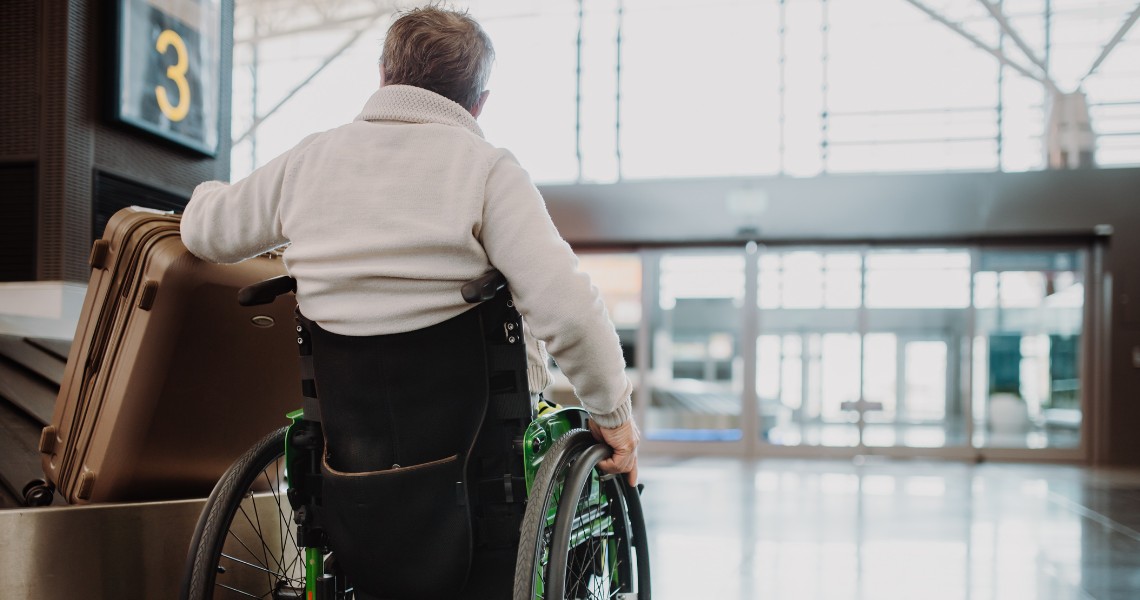
Ask just about anyone who has flown with a disability and they’ll likely tell you the same thing: it’s rarely the journey that leaves them feeling truly exhausted, it’s the accumulation of little things that can go wrong, coupled with the stress of the possible big things (like damaged or lost mobility equipment) that wears you down the most. It can be as simple as a booking form that doesn’t ask the correct questions to the staff at the gate who didn’t receive word of your impending arrival, nor your needs. Then there’s the nightmare scenario where your mobility aid returns to you in a broken state, or worse still, doesn’t return to you at all.
A new study out of Breda University of Applied Sciences (BUas) in the Netherlands has put a name to that pattern: the cumulative effect of barriers. And it confirms, with academic rigor this time, something our community has been banging the drum about for decades.
Researchers tracked the full air travel journey, from booking through to baggage claim, and for passengers with a wide range of disabilities, including wheelchair users, people who are blind or have low vision, Deaf and hard of hearing passengers, and those with a hidden disability like autism, anxiety, and the literally thousands of other conditions they may have. Rather than measuring one stage in isolation (say, boarding, or wheelchair handling), the study looked at how barriers at each touchpoint connect to and compound one another across a single trip.
The headline concept is the cumulative effect of barriers: the idea that no single failure needs to be catastrophic for a trip to become exhausting and undignified. These so-called smaller failures may, on their own, be enough to totally derail a day’s travel. But strung together, across booking, security, boarding, the flight itself, and arrival, they form a pattern that the study argues is the real barrier, not any single broken process. That’s the difference between “the airline made a mistake” and “the system is built in a way that produces this outcome reliably.” Anyone who has had to re-explain the same access need three times to three different staff members in one terminal will recognize it immediately.

The study arrives as the EU Accessibility Act enters its second year in force (something we covered in Europe’s Accessibility Act: What You Need to Know), and roughly 1 in 4 adults in the EU live with a disability. BUas is running this research as part of INCLAVI, an EU Erasmus+-funded project bringing together university partners across Europe to build the curriculum and training that inclusive aviation actually requires, rather than leaving it to individual airlines and airports to figure out staff training on their own. It’s a notable shift from how most accessibility coverage treats these stories: a denied boarding, a damaged wheelchair, a missed connection because assistance never showed up, each usually gets covered as a one-off incident. This project treats it as a systems and education problem, and is trying to fix it at the level of how staff are trained in the first place.
The study’s suggested fixes track closely with what disabled travelers have been asking for directly: clearer legal obligations and standard operating procedures that staff actually follow, better physical accessibility at airports, digitalizing the parts of the process (like disability information at booking) that currently get lost in handoffs between departments, and specific improvements to cabin safety and accessibility rather than treating disabled passengers as an afterthought to standard procedures. The recommendation that stands out most is a call for co-creation: designing services and infrastructure with disabled passengers involved from the start, not consulted after the fact. Most of the “accessibility improvements” travelers encounter were designed by people who don’t use them.
Honestly, not much changes for your next flight. Research like this builds the evidence base that eventually shapes policy and training standards, but that’s a slow process, and the EU Accessibility Act itself shows how long implementation can take even after a law is on the books. It’s worth reading alongside our earlier piece on wheelchair users and flight protections, which covers where US policy currently stands and how differently that story has played out.
What this study does well is validate something the community has known without needing a peer-reviewed paper to prove it: it’s not usually one bad actor or one broken wheelchair lift. It’s the accumulation. If you’ve experienced your own version of this, a chain of small failures that added up to a genuinely bad trip, we’d like to hear about it. Community accounts are exactly the kind of evidence that studies like this one are built on, and they’re what keep this conversation grounded in real trips rather than policy language.
Anthony
Note: I appreciate that this is yet another negatively slanted story about air travel with a disability, which may be quite off-putting for some that are new to the community. To counter this, later this month I will release a follow-up piece where we cover some of the tips you can use to enhance your travel experience and to ensure that everything goes without a hitch when you next have to fly.