/ Opinion & Community Voices /
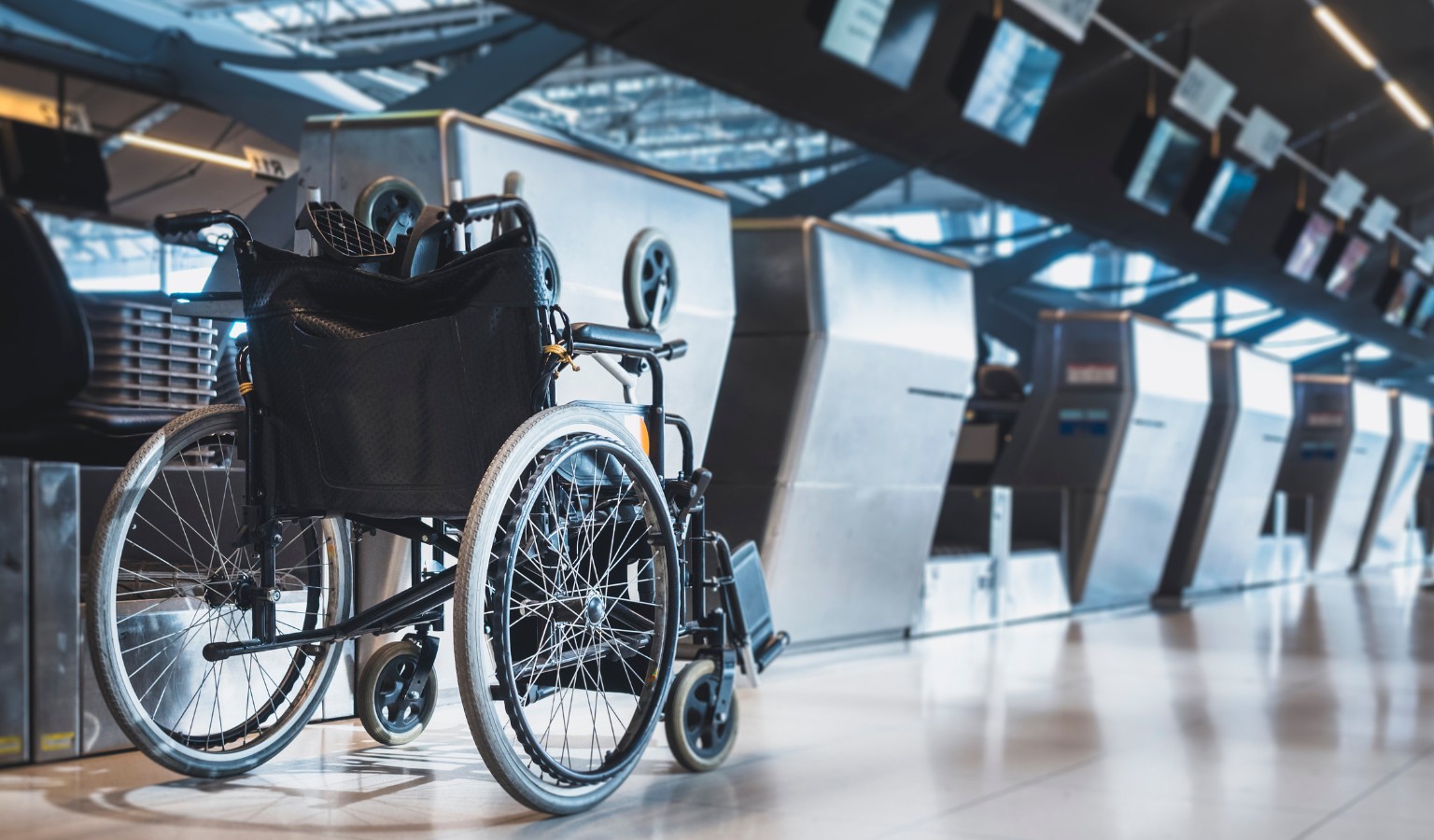
I saw a question posed on social media recently by the accessible travel community tabifolk, where they asked what people’s experiences were when flying with a disability. The replies came in their droves, across multiple Facebook groups and tabifolk’s public page. Folks from Australia, the US, Scotland, Puerto Rico, Spain, Pakistan, and the UK, just to name a few. What was revealed to me in those comment sections, in my opinion, is worth taking some time to talk about.
You see, it looks like while the industry may not be totally broken, it surely is an inconsistent one with a lot of questions to answer. It’s worth remembering, at this opening stage of this piece, that these inconsistencies often land the hardest on those of us who have the least margin for error when things go wrong. Need I remind you all just how life-altering a damaged wheelchair can be.
Seems like a simple question to answer, right? And it is, in the main. But you’d be surprised just how many people feel totally isolated when it comes to the notion of flying with a disability. They believe it to be an impossibility, or, as you’ll later discover in this article, a bad experience decades ago can put a person off trying ever again.
There are people within the disabled community who fly regularly and without incident. I myself have flown around 100 times throughout my life and the worst thing that ever happened was being delayed at Heathrow because we arrived late at night and there wasn’t enough ground staff to get me off the plane in a timely manner. There are many others within our community, including people who passed on their thoughts when asked by tabifolk, who have also traveled frequently by plane and never faced a single issue. Let’s start with some of the positives.

Cory is a quadriplegic traveler who said he’s taken 33 domestic flights and 30 international ones to and from Australia, and has been fortunate enough not to experience any problems across all of them. Likewise, Tobias mentioned that he finds flying from Scotland to be fantastic. Elaine raised a point I often think about: maybe the question might be more usefully directed at airports rather than airlines, since ground staff at the airport are often not employed by the airline directly. She’s right, and it’s something worth bearing in mind, especially when things go wrong and nobody wants to own the situation.
Jose from Puerto Rico has traveled to the Baltics, London, Spain, Portugal, and Orlando with his daughter, who uses a light collapsible electric wheelchair. Their approach is to take control of what they can: collapse the chair themselves, carry the batteries in the cabin, and hand the chair personally to ground crew at the plane door. Delta and JetBlue, he says, were wonderful. And then there’s Dee, who had her best flying experience ever, and her first time flying solo, with Jet2, whose special assistance she described as absolutely perfect.
All of these experiences are real, come first-hand from the people who took those flights, and obviously matter a great deal. The message here is not that flying is impossible for disabled travelers. For a great number of people it works out like a charm. But the gap between those experiences and what others describe as an absolute nightmare is so wide that it’s hard to look at this industry as one with a broadly consistent standard.
The clearest pattern in the comments tabifolk received isn’t, as mentioned, that everything is bad. It’s more that flying with a disability is a bit of a lottery. You never quite know, ahead of arriving at the airport, what you’re going to get.
While Tobias did mention several airports and airlines that were fantastic, he also warned that other experiences have been nothing short of awful. Another commenter, Ali, who is an ambulatory wheelchair user and who flies regularly out of Birmingham Airport in the UK, described the special assistance team there as routinely poor. She referenced disengaged staff, chairs that don’t arrive at the aircraft door despite being correctly labelled, and having to fight for the most basic of things on every journey. There was even one occasion where the captain personally demanded that someone go and retrieve her wheelchair.
And yet Ali still flies from Birmingham, because the stress of getting to a different airport is its own problem entirely. This is the exact kind of binding situation that disabled travelers face all the time. It’s not simply a case of choosing between a good option and a bad one. It’s often just choosing between different kinds of difficulty.
Moving on, Nancy spoke about how her travel agent got the accessibility instructions completely wrong before a trip involving Lufthansa and Frankfurt Airport. She praised both the airline and the airport for managing to recover the situation, but it adds another dimension to the complexity of flying with a disability. Even when the airport and airline are seamless, problems can still arise elsewhere.

This is actually a good moment to mention our partners at Fora Travel. Fora specializes in accessible travel planning, and working with an advisor who genuinely understands the needs of disabled travelers can make a real difference at the booking stage, long before you’re standing at a check-in desk trying to explain what went wrong. If you’d like to get in touch with their team, you can do so here.
Then there was Carol’s comment. Carol was on an ambulift at Nairobi Airport when it broke down mid-air, with around 15 people on board. It took over an hour for maintenance to arrive with a replacement, passengers were transferred one at a time, and they all narrowly missed their connecting flight to Mombasa. Here we have a scenario where there’s no one really to blame, save for perhaps maintenance being too slow to respond or failing to keep equipment in proper working order. But it is yet another layer of difficulty. Equipment failing exactly when it’s most needed.
Speaking of additional layers of difficulty, Sheila’s husband had her wheelchair battery confiscated by EasyJet because it exceeded the permitted wattage limit. Admittedly, upon research, Sheila and her husband realised the wattage was indeed too high. But once again, this is just another thing to contend with when you are a passenger with a disability. We don’t know what it’s like to simply saunter up the steps to a plane and plonk yourself down for a restful flight.
Some of what people shared goes beyond frustration, into territory that’s genuinely hard to read.
Deeva wrote about her honeymoon in Las Vegas, 26 years ago. She boarded a plane for the first and last time. When she landed, her electric wheelchair was returned to her in pieces. Not just damaged. In actual pieces, scattered across the floor. No tools, no replacement chair, no assistance, no apology. She described sitting on the ground surrounded by broken parts, humiliated, frightened, stranded. She hasn’t flown since.
For wheelchair users, this is the thing that hangs over every flight. A damaged suitcase is annoying. A destroyed wheelchair is the loss of your independence, your mobility, your dignity, at the very moment you’ve just arrived somewhere new and need all of those things. If it happens to you, there are steps you can take, but the fact that passengers need a guide for this at all says plenty about where accountability currently sits.
Marie planned carefully for her husband’s eight-hour flight to Spain, booking a seat directly behind the bathrooms and paying extra for it specifically because he could use the overhead cabins and wall to navigate to the bathroom. An air marshal wanted that seat. When Marie refused, the pilot was brought in to insist they move. They moved. She’s still angry about it, and about the fact that she gave in.
This is not an isolated dynamic. We covered it recently when British Airways denied a disabled passenger boarding over bathroom access, a situation that keeps repeating itself across airlines and passengers, with the same justifications and the same outcomes. The pattern is consistent enough that it’s hard to call it a series of individual incidents.
The same frustrations surfaced in the Wheelchair Accessible Places and Activities Facebook group, where the responses were more pointed.
Tina shared that American Airlines damage her daughter’s wheelchair twice. On a separate trip, Dubrovnik Airport put the wheelchair on the wrong conveyor belt, not at the plane door where it should have been, and her family spent five days on a cruise without it. Kristie-lee shared that her son had a serious accident during a transfer into an aisle chair with Jetstar. She emailed the airline repeatedly. They passed responsibility to ground staff. Ground staff said nothing. Her conclusion: unless she wanted to sue, there was no real path to accountability. “Flying is disgusting in Australia,” she wrote. “The procedures are redundant.”
Laura’s husband has been asked to stand multiple times during flights despite being a wheelchair user, and was dropped on one occasion. On another trip, family members had to physically lift him. She’s done the calculation and decided it isn’t worth it. Sadly, this is a reasonable response to repeated institutional failure.
Susan uses a mobility scooter and says she will never fly alone again. She now travels with a printed copy of the airline’s own accessibility policy, with the relevant sections highlighted, to hold staff accountable for what the policy actually says.
In the Accessible Travel Facebook group, the word that appeared most often, sometimes as a full comment on its own, was “humiliating.” One commenter wrote just that. Others wrote “humiliation and not good,” “horror,” “disgusting.” These are people for whom the experience is so consistent and so familiar that a single word covers it.
Cameron said he’ll never fly BA or go through Heathrow if he can avoid it, describing the airline as having declined to something closer to a budget carrier in terms of how it handles disabled passengers. Matt flies mostly with Delta and Alaska and has never had a serious issue. Wendy said Virgin Atlantic was without doubt the best airline she’d experienced as a wheelchair user, though she noted it comes at a significant price premium. Then there is Russell who pointed out something telling: since moving from forearm crutches to a manual wheelchair, he’s noticed how few airport and immigration counters are lowered to a height that works for a wheelchair user. He hasn’t had major difficulties, but the design of airports still treats him as an afterthought.

Another commenter, Sean, said it plainly: it will never be fully fixed until wheelchair spaces are available on aircraft. He means on the plane itself, the structural design problem that no amount of improved ground handling resolves, because it means wheelchair users always have to transfer, always have to hand their equipment over, always have to trust that what comes back at the other end is what they gave.
The people who fly without issue and the people for whom it has caused genuine harm aren’t living in different realities. They’re navigating the same industry, and the difference between their experiences often comes down to factors largely outside their control: which airline, which airport, which shift, which staff member happened to be on duty that day.
That’s the problem. Not that it’s always terrible, but that the floor is so low and the ceiling so dependent on luck. Disabled travelers deserve a baseline that doesn’t require them to carry their own policy documentation, personally hand over their equipment, brief the captain, or spend years not flying because of what happened the last time they tried.
And yet, for every Deeva who hasn’t flown in 26 years, there’s a Cory who has taken 63 flights without incident, or a Dee who stepped off her first solo flight feeling like she’d accomplished something huge. The goal of this collection of comments and insights isn’t to talk people out of flying. It’s to make the good experiences the norm rather than the exception, and to keep the pressure on an industry that has the means to do better, and knows it.
The conversation is continuing in tabifolk’s Flying with a Disability group. If you have an experience to share, good or bad, that’s the place to add it.
Comments in this piece were drawn from The World is Accessible community, the Wheelchair Accessible Places and Activities Facebook group, and the Accessible Travel Facebook group, in response to a question originally posed by tabifolk.