The 5 Most Accessible Hotel Chains, According to Disabled Travelers

Man in a wheelchair works on a laptop and takes a phone call in a spacious, accessible hotel room with a city view.

This piece originated from a poll in our Facebook group, part of TWIA’s community-sourced data.

We recently asked our community which hotel chain they trust to actually meet their access needs, no matter where in the world they’re staying. Over fifty people replied, and while nobody pretended any chain is flawless (plenty pointed out that accessibility still comes down to the individual property, not the logo above the door), five names came up again and again. Here’s what those chains actually commit to on paper, and why our readers keep going back to them.

Hilton (US and beyond)

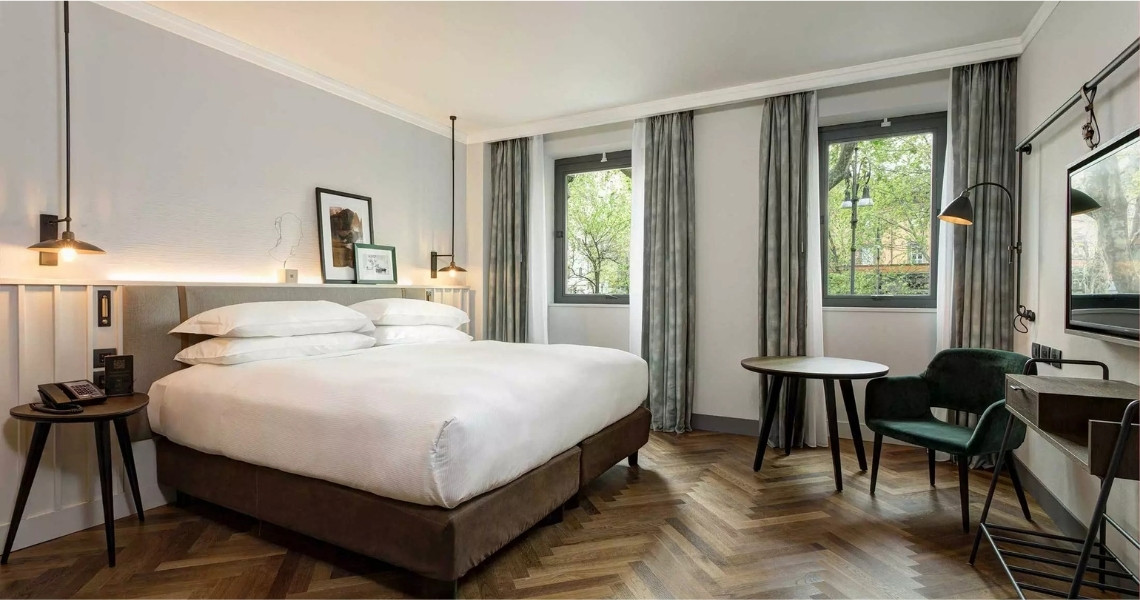
Hilton was the clear runaway favorite among those who responded to our question, and one of the biggest reasons seems to come down to the accessible rooms themselves. Hilton offers two distinct types: one with a bathtub in the bathroom, and one with a roll-in shower. It’s also not unusual to find a room with two beds rather than the single king you’ll often get elsewhere, which matters if you’re traveling with someone who needs their own bed too. Because these room types differ so much, and Hilton is upfront about that, you’ll want to confirm exactly which one you’re booking rather than assuming “accessible room” covers everything you need. Hilton is also honest that no two hotels are quite the same: bed height, layout, and bathroom style can all shift slightly from one property to the next, even though every room is meant to meet the same basic accessibility standards. A few of our readers flagged that inconsistency creeping in lately too, like toilets sitting too low or beds too high, which lines up with Hilton’s own disclaimer that features “may vary by hotel.” 

Holiday Inn Express (US and beyond)

Holiday Inn Express, IHG’s budget-friendly brand, showed up several times in our poll, and it tends to get chosen for practical reasons more than any single standout feature. Across its US properties, IHG’s official accessibility listings describe rooms with grab bars, raised toilets, and enough turning space to maneuver a wheelchair, as well as tubs with grab bars and portable bathtub seats or handheld showers for those who prefer them. Getting into the building tends to be straightforward, too, with van-accessible parking, curb cuts, flat routes from the lot to the entrance, and ADA-compliant elevators that connect to public spaces like the fitness center, business center, and pool. Some individual properties, like the Holiday Inn Express in Berkeley, California, list a dedicated two-bed, hearing-accessible, roll-in shower room as its own booking category, though this varies by hotel rather than being a guaranteed brand-wide feature. Our readers who named Holiday Inn Express tended to use it less as a first choice and more as the reliable backup when Hilton wasn’t available locally, particularly across Australia and New Zealand. And the brand does have a presence outside the US worth knowing about too: IHG’s UK properties list their own baseline of designated accessible parking, induction loop systems, and assistance dogs welcome as standard, with a handful of hotels, including Crowne Plaza London – Heathrow, Holiday Inn Cardiff City Centre, and Holiday Inn Birmingham M6, Jct. 7, going further with ceiling track hoists (though you’ll need to bring your own sling, since the bedroom and bathroom units aren’t connected), according to IHG’s Access for All page.

Marriott (US specific)

Marriott split opinion more than any other chain in our poll. Some readers swear by it, but one respondent called booking an accessible room “a nightmare of complications,” and it turns out that’s not just a one-off gripe. In June 2024, the US Attorney’s Office for Colorado found that guests with disabilities were regularly running into accessible rooms that simply weren’t listed in Marriott’s central reservation system, weren’t bookable through third-party sites like Expedia, and couldn’t always be reserved with Bonvoy points. Marriott agreed to fix all of that with a more accurate inventory of accessible rooms across its centralized system, visible availability on major booking platforms, expanded points redemption, and staff training on accessible reservations, alongside a $50,000 civil penalty. The agreement covers 24 Marriott brands in the US, so if you’ve had trouble booking with them before, it might be worth trying again now that the reservation system is supposed to reflect what’s actually available.

Premier Inn (UK specific)

Premier Inn’s showing skewed heavily UK-based, which makes sense given its footprint, but the specifics readers gave were some of the most concrete in the whole poll: wheelchair-height baths, food available on site, and one reader’s mention of a free adjoining carer’s room with a lockable connecting door at the property they stayed in (a nice touch if you can find it, though it’s not something Premier Inn’s own accessibility page confirms as a standard feature). Premier Inn’s own accessibility terms do back up a good chunk of the rest. Beds in accessible rooms come in either 480mm or 520mm heights to match wheelchair seat level, and bed raisers can be requested in advance, though only for the 480mm beds. The 520mm beds are actually built with enough clearance for a mobile hoist if you need one, though Premier Inn doesn’t supply hoists themselves, so you’ll need to bring your own. Wet rooms with level-access showers are available in some newer or recently refurbished hotels, while most older properties still have the shallower baths with grab rails. They’re transparent about where they’re headed too: every new build and extension going forward will split its accessible bedrooms 50/50 between wet rooms and accessible baths. One caveat worth flagging for anyone relying on this chain: Premier Inn is explicit that it cannot offer personal care. There’s a dedicated accessibility team you can reach at pi.accessible@premierinn.com or by phone on 0333 0919 817 (Monday to Friday, 9am to 5pm), and they aim to reply to accessibility enquiries within 24 hours.

Drury Hotels (US specific)

Drury rounded out the top five with fewer mentions than the others, but the reasons given were specific and consistently positive: clean, well-priced, pet-friendly up to 80lbs, and free breakfast and dinner included. Drury states that its properties comply with the 2010 ADA Standards for Accessible Design, and unlike some chains, it lets you choose between a roll-in shower or a traditional tub at the point of booking rather than leaving it to chance on arrival. Hearing-impaired kits and bathtub benches are available on request, and service animals stay free of charge. The one thing to watch for is parking: five downtown properties — the Drury Plaza Hotels in San Antonio Riverwalk, Cleveland Downtown, Pittsburgh Downtown, and Santa Fe, plus the Drury Inn & Suites New Orleans — are valet-only with no self-parking option, which is worth checking before you commit if any of those are on your route.

Source: Drury Hotels: Hotel Accessibility


The pattern across all five, and something several of our own community members said outright, is that the chain name is really just a starting point. Even the best policy on paper can look different at an individual property depending on when it was last renovated and how well local management understands what “accessible” actually needs to mean. Calling ahead and asking for photos or exact measurements before you book is still the only real guarantee, whichever of these five you end up choosing.

Leave a Reply

Your email address will not be published. Required fields are marked *

This site uses Akismet to reduce spam. Learn how your comment data is processed.